Pagasa: Amihan, easterlies to bring rains in PH Saturday — Does the Headline Support the Claim Beside It?
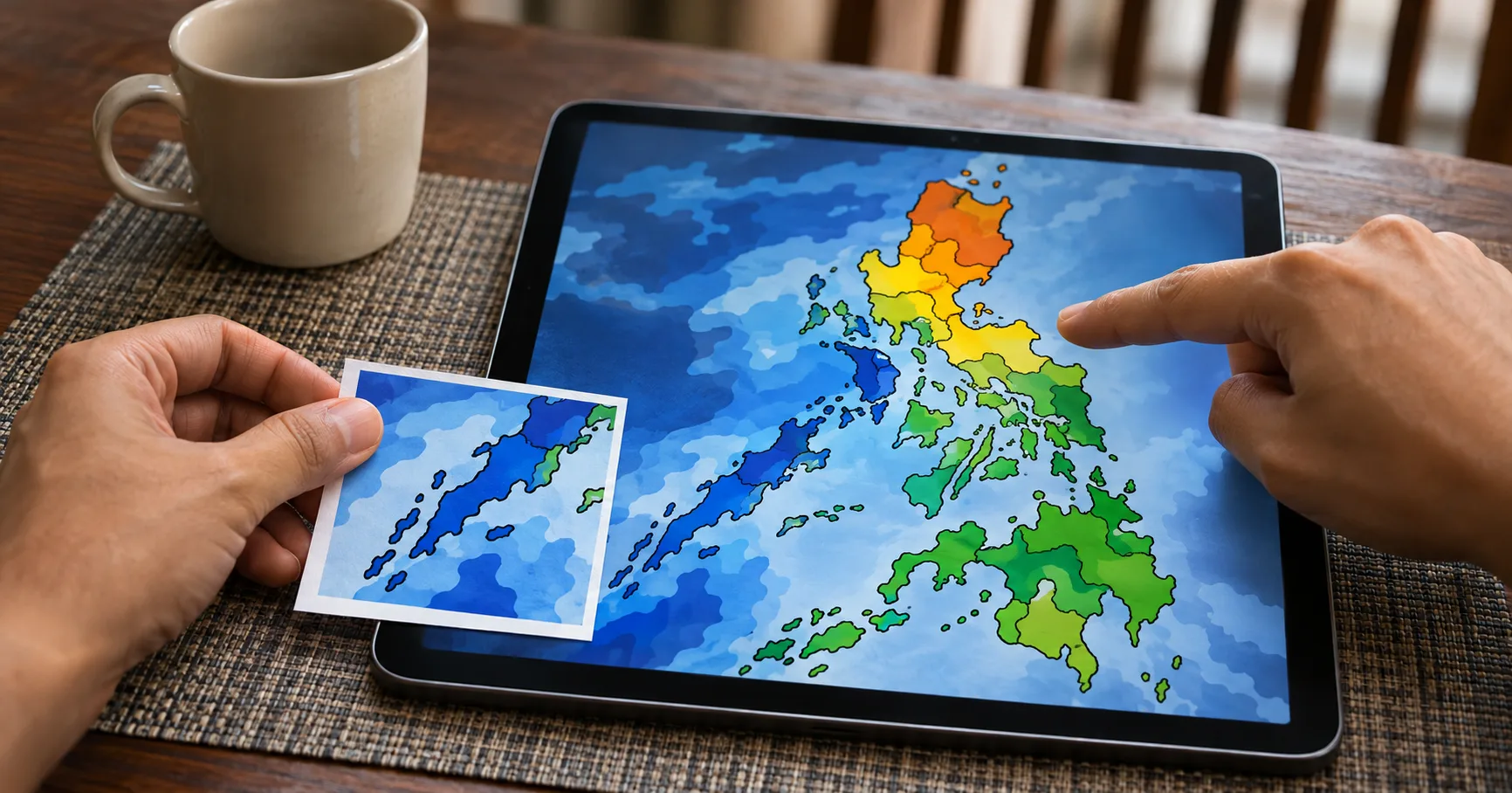
You are at home in the Philippines, checking a Saturday rain headline on your phone while deciding whether to head out or stay indoors.
The wording catches your attention: “Pagasa: Amihan, easterlies to bring rains in PH Saturday.” A shared image may place that headline beside a warning about disrupted services, an offer, or instructions to send money. Those additional claims need their own evidence.
Read the headline as a starting point for verification. It names weather systems and a day, but the wording alone does not establish which forecast applies to your location. It also cannot establish whether a payment service is working.
Before a deposit, separate the forecast from the sales pitch
A weather report and a payment instruction answer different questions. The report concerns expected conditions; the instruction asks you to move money. Even when they appear inside the same post, evidence for one does not establish the other.
For a weekend player considering a longer online casino session, the distinction matters: a credible PAGASA reference does not establish that a casino deserves a deposit.
The same reasoning applies to an e-wallet transfer or payment-centre errand. A rain headline cannot confirm an account number, explain an individual pending transfer, or establish that a service charge is legitimate. Check those matters through the relevant service itself.
Consider a hypothetical PHP 500 payment followed by a PHP 100 request described as a weather-related release charge. Paying both would expose PHP 600. The extra PHP 100 equals 20% of the original payment, but that calculation says nothing about whether the charge is authorised.
The useful question is where the charge appears in the service's own terms or transaction record. A familiar weather headline cannot supply that answer. Use the same distinction when applying a pre-deposit verification checklist to any payment destination.
Six steps for testing the headline against its destination
Keep the original post available while you check its source. Moving between the post, the full report, and the destination page helps expose changes in wording. You are comparing claims, not collecting familiar logos.
- Open the complete report behind “Pagasa: Amihan, easterlies to bring rains in PH Saturday,” rather than relying on a cropped image or caption.
- Read the publication date and forecast validity together, then establish which Saturday the report describes before applying it to your plans.
- Locate the places named in the full PAGASA report and compare them with your actual destination, rather than assuming “PH” means identical conditions everywhere.
- Separate statements attributed to PAGASA from the publisher's explanation and any comments added by the account that shared the report.
- Inspect any payment destination independently, checking its company identity, written terms, support route, and recipient details before entering personal information or sending money.
- Compare the post's practical instruction with its evidence, asking whether the source actually supports a closure, interruption, extra charge, or deadline.
The first comparison concerns time. “Saturday” is a weekday label, not a complete reference. A saved image can retain convincing formatting after its forecast period has passed. Read the date inside the report instead of treating a fresh share as a fresh forecast.
The second comparison concerns geography. “PH” gives the headline a national frame, but it does not specify the conditions at your home, payment centre, or planned destination. Follow the report's location wording without expanding its scope yourself.
The third comparison concerns attribution. A publisher may summarise a PAGASA bulletin, while a separate account adds advice underneath. That advice may be reasonable, mistaken, or unrelated. Its position beside the headline does not make it part of the bulletin.
A hypothetical example shows the difference. Suppose a post repeats the rain headline and adds that a PHP 50 transfer surcharge applies after 6 p.m. The forecast does not substantiate either PHP 50 or 6 p.m.; both need confirmation from the payment service.
For the destination page, a visible company name is only a starting point. Compare that identity across the terms, contact information, and payment instructions. If those details conflict, resolve the conflict before treating the page as trustworthy.
When the surrounding message asks you to believe more
Warning signs often appear in the leap between a weather statement and a demanded action. The headline can be accurately reproduced while the surrounding instruction remains unsupported. Read the entire message with that distinction in mind.

- A post quotes PAGASA but requests a PHP 100 release payment without directing you to a matching charge in the service's own records.
- A caption treats the word “PH” as proof that every payment centre is closed, without identifying a branch or its operating notice.
- A message adds a 10-minute payment deadline even though the linked forecast contains weather information rather than a payment-service instruction.
- A supposed helper requests your password or verification code while offering to resolve a transfer mentioned beneath the Saturday weather headline.
- A destination page changes the expected recipient or redirects payment to a personal account without an explanation you can independently confirm.
- A screenshot removes the publication details and location wording while preserving a dramatic headline and an instruction to forward it immediately.
These signs justify pausing and checking; they do not, individually, establish every fact about the sender. An incomplete crop may result from careless sharing. A request for account credentials, however, creates a separate reason to stop interacting through that route.
Suppose the original amount is PHP 500 and the message adds PHP 100 for release, then PHP 200 for verification. The proposed total becomes PHP 800. Each new request requires evidence; paying an earlier amount does not validate the next one.
Pressure also changes how people read. A 10-minute countdown can push you toward checking only whether PAGASA appears somewhere on the page. Slow the decision enough to inspect the actual recipient and instruction. Recognition is weaker evidence than a matching record.
Keep a service interruption separate from a payment dispute
A loading screen, a weather headline, and an incomplete transfer can appear together without proving a shared cause. Treat the transaction status as a question for the payment service. Treat the forecast as a question for the weather source.

This distinction is especially useful when switching between home internet and mobile data during a longer evening at home. A refreshed page may look different from the previous view. That visual change alone does not tell you whether money moved.
In a hypothetical PHP 500 transfer, repeating the instruction could create another PHP 500 transaction if both requests are accepted. That would mean PHP 1,000 sent rather than PHP 500. Check the transaction record before deciding what another tap should do.
If a payment is disputed, organise the evidence around the amount, recipient, and status. Include the weather-related message when it explains the requested charge, but keep it separate from proof of the transfer itself.
- Save the payment reference, amount, recipient details, and displayed status, alongside the original message that connected the payment request to the weather headline.
- Check the transaction history through your usual service entry point before repeating a PHP 500 payment that appears incomplete on another screen.
- Contact the payment provider through its established support route, describing the disputed instruction and asking what the recorded transaction status means.
- Request a case reference and a written explanation of the disputed charge, including the relevant terms if someone claims an additional payment is necessary.
- If you disclosed account credentials, use the service's account-security controls and report the disclosure without sending passwords or verification codes in follow-up messages.
A concise report is easier to assess than a long account of the weather. For example: “I attempted PHP 500. My history shows this status. A separate message requests PHP 100. Please confirm the transaction and whether that charge belongs to your service.”
Keep copies of replies under the same case reference. If the explanation changes, ask which record or term supports the revised answer. The payment dispute evidence guide can help you organise the material before your next support exchange.
For an in-person payment-centre visit, check the specific branch's operating information before travelling. Neither a national headline nor a stranger's comment confirms that branch's availability. The practical decision depends on the destination you actually intend to use.
Questions that keep the claim within its evidence
Does the headline mean rain will affect my entire Saturday?
The headline alone does not establish duration at your location. Read the full forecast's place names, timing, and conditions before making that inference. “Saturday” identifies a day; it does not by itself mean continuous rain throughout that day.
Can an accurate PAGASA headline make an attached offer trustworthy?
No. The weather claim and the offer require separate checks. Confirm the report through its source, then assess the offer through the destination's identity, terms, and payment instructions. Accurate information in one part of a post cannot validate every other part.
Should I pay an extra charge when a message blames the weather?
Check the charge through the payment service's own records and support route before paying. In a hypothetical PHP 500 transfer with an added PHP 100 demand, the extra amount remains a separate claim. A rain headline is not evidence that the service requires it.
What should I share when someone asks whether the headline applies?
Share the complete source link with its publication details and relevant location wording. Keep your own interpretation separate from the report. Avoid adding claims about payment delays, branch closures, or charges unless you also have evidence from the service concerned.
For your own Saturday plans, let each source answer the question it can actually resolve. Read PAGASA's forecast for weather context, check branch information for an errand, and use transaction records for payments. Keep those checks separate even when one shared post combines them.